May 23, 2014

What Say You: In Defense of Fun in Architecture


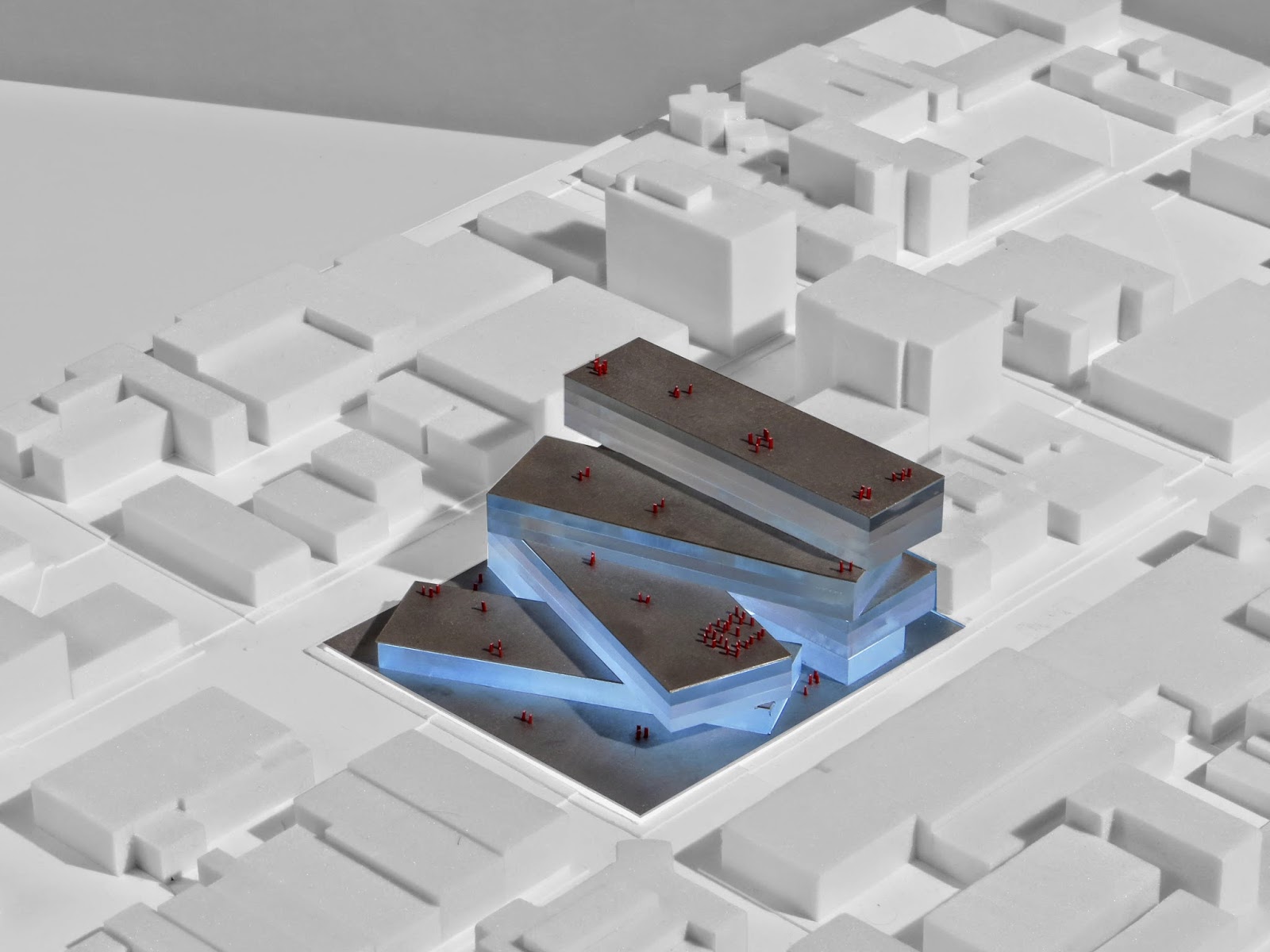
  A block model of Santa Monica shows the downtown area and the concept plan for the 4th St, 5th St. and Arizona Ave. project.  The building levels are created by a series of "hinged bars" to allow the plaza and the building roofs to be used as public outdoor space with views to the ocean and the mountains.  Concept design by OMA.  
photo credit OMA


What Say You:  In Defense of Fun in Architecture
SUSAN CLOKE
Columnist

Architecture has been in the news in Santa Monica, but not in a good way. Now, in the midst of all the noise of development, comes another project.  Located on Arizona Ave between 4th and 5th Streets.  And this time the client is the City of Santa Monica.

After a selective process the City partnered with John Warfel of Pacific Metropolitan Capital to lead the project development and the architecture firm OMA, (Office of Metropolitan Architecture) led by Rem Koolhaas to design the project.

Koolhaas is an architect on a quest for making meaningful architecture representing the culture and ethos of time and place.  Koolhaas is as well known for his thinking and writing about architecture, cities, and how people use buildings and public spaces as he is for his design work.  U.S. projects include the Seattle Public Library and the Milstein Hall at Cornell University.   http://www.oma.eu/projects

With the defeat of the Hines proposed project a warning shot has been fired, not for the first time, across the bow of large-scale development in Santa Monica.  Criticism is mainly focused on scale and density but often accompanied with comments that the architecture was boring, dull, not fun, not Santa Monica.

On May 15 about 75 Santa Monicans came together at the Main Library for a presentation of concept designs of the Arizona Ave, 4th St., 5th St. project.  Currently named the Plaza at Santa Monica.  http://theplazaatsantamonica.com/

Shohei Shigematsu, the OMA partner representing the firm at the Santa Monica meeting, introduced the firm and talked about the way OMA thought about the project.  “We embraced the culture and the climate of Santa Monica and we focused on the public realm.  The concept is one of a series of open, hinged bars. This allows us to follow the California tradition of bringing the outside in and the inside out.”

The project proposal is for a public building that includes commercial and retail areas, affordable housing (working with Community Corps), a children’s museum, plazas and parks, public events, terraces, a hotel, residences and the ice rink.

Shigematsu said, “Transportation and parking are major concerns in Santa Monica.  We will design to make this a fun and easy place to walk.  The sidewalks will be wide and have good street furniture.  It is also designed for transit connections, for bike users and has a strong Transportation Demand Management program (TDM – a program which mandates measures to reduce parking and traffic to the site, especially at peak travel times.)  Parking lots will be day lit with skylights.”

OMA added to the transit connections by showing a playful option for bringing back the historic gondolas to connect the Plaza to the Pier and beach.

Two versions of the project were presented.  One at 148’ in height and one at 84’ in height.  Both used the hinged bar concept, allowing each roof to be used as an outdoor public space.

People attending the meeting commented on the openness of the design and the use of natural light and air, some preferred the 148’ design saying it was more open; Residocracy spokesman Armen Melkonians said Santa Monica residents would not accept a project higher than the 84’ allowed by zoning;

Shigematsu, in a follow up interview, said about architecture, “Iconicism comes from use and memory and represents shared culture.  Iconic space is something that develops over time, when a place feels special.  That understanding of iconicism is why we looked at other public spaces in Santa Monica and worked to understand what it is that makes places special to the people of Santa Monica.

“So we purposefully designed a building with the intent that it respond specifically to the climate and to the people of Santa Monica.  There is a Children’s Museum on the ground level.  It gives a cultural heart to a commercial periphery.  The design is specific to Santa Monica weather.  We designed for inside/outside proximity.  The hinged bars of the concept design are in response to Santa Monica and the breezes, the air and the sun, and the idea of life lived indoors and outdoors.

“Santa Monica is a City that promotes sustainability and this building will achieve a LEED Gold status through energy efficiency, cooling and natural ventilation, the use of recycled water, a screen to reduce solar gain, use of recycled materials, bike stations, and water on the roof for fun, for beauty and for cooling.

“OMA was given certain parameters of design and a building program and we designed within those parameters.  Our first concept plan was for a 148’ building.  We were then asked to rethink the project at 84’.   It was a necessary step to make the project into 84’ but it is more difficult.  We are the ones who translate people’s desires and we do our best to deliver the best translation.  I am not just talking about height; I am also talking about architecture and the fundamentals of design.

“This design, from ground to sky, is a continuation of public domain.  We have an image of the building as theater where people will come together and we really believe in that image.”

The concept design proposed by OMA, expresses the culture and values of the City: open to the sun and air on every level, yoga on a roof terrace, the ice rink in winter, fountains in summer, open air cafes, year round programming of public events, food markets, museum events, film screenings and maybe even gondolas. Add sustainability, affordable
housing and a welcome for bicycle riders and you know it’s Santa Monica.

Now comes the public conversation about height, scale and density. And height, scale and density are dependent on program – how many housing units, what size hotel, how much commercial space, how much public space. 

From that discussion will come a decision by the Council; one which needs to be based on an open and transparent public conversation.  The conversation continues at the June 10 Council meeting.

What Say You?


May 9, 2014

Hometown Hero:  Kate Vernez 
The Art of Being Purposeful. 
Kate Vernez
Deputy City Manger for Special Projects
City of Santa Monica
SUSAN CLOKE
Columnist
May 9, 2014

Kate Vernez, speaking about her work with the City of Santa Monica, said, “What I resonate with are collaborations with other people to have a successful outcome and to be purposeful.” 

27 years ago she and her family left their work and life in New York City to move to California. It was 1987 and she competed for a job as a policy analyst in the City Manager’s office. She started her work with City Manager John Jalili and continued to work with City Managers Susan McCarthy, Lamont Ewell and Rod Gould.  Now, Vernez, who is the Deputy City Manager for Special Projects, is leaving her work and making plans for the next chapter of her life.  “I leave the City with a sense of gratitude and appreciation for being allowed to hold the reins for a while,” she told me with great feeling in her voice.

Vernez has worked on many big projects for the City including the creation of the Child Care Master Plan, the Palisades Park Master Plan and the Telecommunications Master Plan, as well as homeless issues and environmental issues.  She said the most important work of her time is the work to bring Expo to the Westside.  “The Westside is the 2nd major job center in Los Angeles County and was without a rail connection to downtown Los Angeles. http://www.westsidecities.org/projects/ToolKit.pdf

In speaking about Expo, County Supervisor Zev Yaroslavsky, whose Third District includes Santa Monica, praised Kate Vernez as “a steady hand at the local government helm.  Expo is the most significant public works project to hit Santa Monica since the building of the I-10 freeway in the 1960’s.  The plans for, and construction of, the light rail line could have been a contentious political/neighborhood issue in the city.  Kate was able to anticipate problems before they became problems, which allowed us to plan accordingly.  Instead of a controversial project, Expo was better received in Santa Monica than at any other point along the route.”

“Expo was born out of controversy over traffic,” said Vernez.  “We brought a coalition together, to weather the ups and downs.  We achieved something remarkable at the end of the day.”

The City had been planning for Expo for years.   There was all the backbone of infrastructure.  The City had preserved the Exposition right of way. It had purchased the properties for the Bergamot and 4th Street stations.
§  Council Member Pam O’Connor was appointed to the MTA Board and made the motion to build the Expo line all the way to Santa Monica.
§  The City advocated for a third Santa Monica Station at 17th Street.  One that would serve Santa Monica College and the hospitals.
§  The Council set aside funds for  ‘betterments’ and paid for a 2nd entrance and dual platforms at the Bergamot Station, a 2nd entrance at 17th St., and the 4th Street Station redesign.
§  The Expo Construction Authority:  Santa Monica got State legislation to create a single purpose entity to oversee expenditure of money and construction details for Expo, making sure “the build” is done correctly.

“The 4th Street Station is the terminus for Expo,” said Vernez. “The beauty is that you get off the train to a seamless ribbon connecting Expo riders across to the downtown, to the pier, the beach, City Hall, and the Promenade.

“It’s a partnership: Expo, the City, the community working together to get this built.  The community has been involved and supportive from day one.  Their willingness to invest in bringing Expo to Santa Monica was essential to the project.  You can even see this investment expressed in the response to construction in that there are fewer complaints than would be expected for a project of this size and timeline. 

“Because the city had long ago reserved the right of way and had purchased the land at Bergamot and at 4th Street, we were standing in line.  And we drew upon our regional partners to write a mobility plan outlining Westside housing density/ridership. 

“Bringing all the power sources together to make an incredibly strong advocacy alliance. That was exciting,” said Kate, calling herself a ‘policy wonk.’

“It’s difficult to move on from this work which I have found so meaningful and satisfying.  But it is the right time to think about the big life changes. 

“When my husband and I left our wonderful work in New York City for California, part of why we wanted to move was to be able to have both interesting work and more time for our family.

“Now my eldest daughter and her family live in London.  I have one granddaughter and another coming in June and family comes first for me.

“My work in New York and my work in Santa Monica always included working in groups with dedicated people to solve problems and make a difference.  Wherever the next chapter takes me I will use my time to be part of projects that make it possible for me to continue to make a contribution.”

When asked about her vision for the future of Santa Monica, Kate Vernez said,  “Collaboration and good communications, keeping everyone informed with rich dialogue, attending to people’s needs, getting the job done - that’s what impresses me.  We are a small community with a great diversity but we know how to come together and get the job done in a human way.”


April 18, 2014

Wendy Greuel
Candidate 33rd Congressional District
What Say You?  Wendy Greuel.  
U.S. Congress.  33rd District. Candidate
SUSAN CLOKE
Columnist
April 18, 2014


“Henry Waxman served the people of the 33rd Congressional District for 40 years.  He changed the lives of individual people for the better and he changed the future of our Country with his legislative work: the Clean Water Act, the Clean Air Act, the Affordable Care Act,” stated Wendy Greuel.

“When I learned the Congressman had decided not to run I took a deep breath and said to my husband, “I want to go to Congress to continue his legacy.”

There are 18 candidates on the ballot for the Congressional seat. Here is why I think Greuel is the one to vote for in this very crowded field, with other candidates often sharing values and also having name recognition.

First, what are my criteria?  I want a compassionate and caring person who believes, as Waxman did, that being a Congress Member is an opportunity to serve and protect the people of the District.  I want a candidate I can rely on.  One that will be effective once elected.  And that means they have to be savvy in the ways of government and politics.  It also means they know how to compromise and how to build consensus.  They know when it’s a good idea to compromise and when compromising would be a betrayal of principle.

So what do we know about Greuel that lets us think she is the best candidate for the job?

Greuel is the only candidate running with demonstrated know-how in successfully maneuvering her way through the bureaucracy that is DC. 

During the Clinton Administration Greuel was tapped by Andrew Cuomo, the Secretary of HUD (Housing and Urban Development), to be the Deputy Director of the Inter-Agency Council on the Homeless and then to be the Regional Director for HUD.

Working in HUD she helped to develop a Homeless Policy that gave 75 million dollars in grants to cities that worked in innovative ways to reduce homelessness and to create a continuum of care.  Santa Monica was the fortunate recipient of some of this grant money.

With Greuel as the Regional Director, HUD gave the whopping sum of 1 billion to the Los Angeles area to help rebuild after the 1994 earthquake.  Santa Monica was a recipient of part of those funds, as 5% of the City housing stock had been damaged in the earthquake.

When GLAD, (Greater Los Angeles Facility on Deafness), was seeking funding for a renovation of their building, Greuel brought the grant decision makers from HUD to the facility and asked them to “look at what will happen if you can’t find a way to give them the grant.” Because she was able to bring them together and show the impact of their decision, GLAD received the grant.

DreamWorks Studio then recruited Greuel from HUD to work for them on philanthropic and political issues.   “DreamWorks was a company that wanted to use its power in a way that would make a difference,” said Greuel.  Representing DreamWorks, Greuel was able to create new jobs in Los Angeles, expand the philanthropic work of DreamWorks and start animation programs in local schools.

Greuel has demonstrated abilities as a legislator and a good government advocate, first, early in her career, working for Mayor Tom Bradley, and later, as both a Los Angeles Council Member and as Los Angeles City Controller. 

In her early years in government, as an Assistant to Mayor Bradley, Greuel was instrumental in securing a vacant building at the Veteran’s Administration for use by homeless Vets.  It seems an obvious idea, but it didn’t come easy.

When the insurance company threatened cancelling the insurance of the Gay and Lesbian Center at the beginning of the AIDS crisis, the Head of the Center, Tori Osborne, called for help.

Wendy was there to speak on behalf of the Center and to propose a course of action to Mayor Bradley.  Bradley then called the insurance company.  The insurance was reinstated.

As a Los Angeles Council Member, Greuel sponsored, among other actions, legislation that funded traffic and transportation improvements, protected 1200 acres of public open space and supported small business owners.

As City Controller, Greuel focused on ensuring fiscal responsibility of the City Departments including the Department of Transportation and the Department of Building and Safety.  Concerned that the Department of Water and Power wasn’t effectively supporting renewal energy, she instituted an energy audit on their renewable energy portfolio. 

Greuel grew up in the San Fernando Valley and went to college at UCLA, studying psychology and economics and political science.  She found her introduction to political work when looking for a summer job.  There was a listing for a position in the Office of the Los Angeles City Representative in Washington DC.  She applied and was accepted.

“I was the guide for Los Angles Council members when they came to DC.  Part of my job, because I was low on the totem pole, was to pick Council Members up at the airport.  I thought it was great because it gave me a chance to talk with elected officials.  It was an inspiration for me.” 

Talking about the Congresswoman she wants to be, Greuel said, “There will never be another Henry Waxman but I promise to be a fighter and a doer.  I’m going to fight to protect the environment and to address climate change.  I’m going to make sure we protect our beaches and our mountains. I will work to reintroduce the Waxman Markey Cap and Trade Bill.  I will work to set a national carbon goal for the Country.  

“I will speak out on women’s rights, education, on civil rights, on LGBT rights. I will protect seniors.  I will stand up for Medicare and Social Security.  I will work to pass immigration reform.  I will never give up on my principles.

“I will work to build consensus.  I so admire the women leaders in the Congress who came together to end the government shutdown and I look forward to working with them.

“We knew Congressman Waxman had it in his gut to do the right thing.  We knew we could rely on him to stand up for people, stand against the special interests. 

“You can rely on me.  I will see the big picture and I will be there for the people of the District.”

For all these reasons I think Wendy Greuel has earned our trust and our vote.

What Say You?


March 28, 2014

What Say You? Closing Santa Monica Airport


World Cruiser Biplanes


What Say You?  Closing Santa Monica Airport
SUSAN CLOKE
Columnist
March 28, 2014

At the Council Meeting of March 25 a unanimous City Council signaled its intent to direct the closing of Santa Monica Airport (SMO) and to work to protect neighbors from noise and pollution impacts until SMO can be closed.

McKeown/Vazquez moved the Staff Recommendation with modifications including an offer to the FAA to repay the grant to extinguish any lingering grant obligations. http://santamonica.granicus.com/MediaPlayer.php?view_id=2&clip_id=3248

During the public comment at the Council meeting assertions had been made that the City was closing SMO so they could build “Century City West.”  Council Member McKeown called the statement a “canard.”  And the McKeown/Vazquez motion directed that concept plans and zoning focus on low intensity uses.

The City anticipates that the decision and design process will be a public visioning process and the language of adopted motion states, “Continue to receive and assess community input of preferences and possibilities for the potential future use of the land.”

It was an hours long meeting with many speakers. Speakers from the organization Airport2Park saw this as a once in a century opportunity and called for using Airport lands for parks that serve all. http://airport2park.org/

People spoke representing neighborhood organizations calling for the closure of the airport due to noise and pollution and public health concerns. Santa Monica residents and residents from adjacent communities spoke about noise, pollution and public health concerns.  Scientists also expressing concern for public health joined them.

Pilots and pilot’s organizations, aviation related businesses and many Santa Monica residents spoke of the importance of the Airport to the City, to the fact that the Airport provided emergency medical transportation for patients in need, that it was an important alternative for receiving help and supplies in case of earthquake.  They also presented information on new technology and innovations that would make the airport quieter and would reduce pollution and health hazards.  Other people spoke of the educational and inspirational importance of the Airport to young people.


­History

The history of SMO is one of excitement and adventure, of the golden days of aviation.  The Wright Brothers first flight, in North Carolina, was on December 17, 1903.  By 1917, even before it was an airport, WWI biplanes used the Santa Monica field as informal landing strip.

Donald Douglas formed the Douglas Aircraft Company in 1922 and produced military and civilian aircraft.  It 1923 the site was dedicated as Clover field by the Army Air Corps, named after the WWI pilot Lt. Greayer Clover, who was killed in action in the war.

Portions of the existing property were purchased by the City with monies from a Park Bond measure in 1926.  After that the Council changed the name to Santa Monica Airport. (SMO)

The Airport first becomes famous when the Douglas World Cruiser biplanes leave from SMO and circumnavigate the globe.

In 1929 SMO got the attention of the whole country and the international aviation community with the race of woman aviators from SMO to Cleveland.  Among the aviators flying in that race were Amelia Earhart and Pancho Barnes.

During WWII Douglas was a major defense contractor with 44,000 workers.  The plant had three shifts, seven days a week.  Sunset Park and other neighborhoods in Santa Monica were built to provide housing for the new workers.

It was also during that period that the Federal Government became involved with SMO to protect the war effort.

The first City/Federal Government Grant Agreement was signed in1941.  In 1948, with the War over, the City resumed operation of the Airport.

It wasn’t until the 1960’s that the first civilian jets arrived at SMO.  Neighboring residents, infuriated by noise and pollution sued the City and the City adopted a series of regulations to respond to resident concerns.

Airport controversy continued and by1974 the City had established the “Airport Neighbors Forum.”  Based on the Forum’s recommendations the City adopted ordinances designed to protect the neighborhoods from noise and other impacts.

With continuing controversy and after additional litigation the City entered into the Santa Monica Airport Agreement (1984) obligating the City to operate the Airport through 2015.  That agreement recognized the City’s authority to mitigate aircraft impacts through noise limits, curfews, a helicopter ban, and pattern flying restrictions.


The Present.

The Staff report states:  “For years, community members assumed that the City could close the Airport in 2015 when the 1984 agreement with the federal government will expire.

“However it is now clear that legal disputes about the City’s authority to close the Airport will inevitably extend well beyond 2015, and their outcome is uncertain.  And, beyond the legal controversies, some level of environmental assessment would likely be required to close all or part of the Airport ant that would take time.” http://www.smgov.net/departments/Council/agendas/2014/20140325/s2014032508-A.htm


The Future.

Looking at the bigger picture of aviation, the one that affects everyone, not just Santa Monica, all of aviation has changed. 

Gone are the romance and adventure and exhilaration of flying.  Once Americans put on their best clothes and sat in comfortable seats on airplanes where all passengers were ‘first class.’  On long flights ‘real food’ was served on china plates.  There were no security lines and family and friends walked with travelers across the tarmac and waved good-bye as people boarded the plane.  Now we only know about those days from old movies.

SMO was wonderful for Santa Monica.  It helped to grow the City.  It provided employment, revenue, innovation, and civic pride.

The Santa Monica of today is still a place of innovation and creativity and civic pride.  The challenges before us now are different.   The challenges are ones of sustainability and stewardship and protection of the environment. 

The questions now are how to continue the ethos of innovation and creativity and be the protectors and stewards of sustainability and the environment.

It will be a Santa Monica responsibility to decide the future of the airport land.  Of equal importance, it will be a Santa Monica responsibility to determine the process of decision-making.

That process, the visioning of the future of the airport lands, needs to meet the criteria of environmental stewardship, public protection and creativity and innovation.  Imagine an inclusive process, one inviting everyone to the table and searching for ways to come to agreement on how to use this unique public land for the benefit of all Santa Monica.

What Say You?


March 14, 2014

What Say You? Drought and Clean Water


What Say You?  Drought and Clean Water
Susan Cloke
Santa Monica Mirror Photo
SUSAN CLOKE
Columnist

“Drought, it’s got everyone’s attention and that’s a good thing.  The storm we had at the beginning of March dropped 2 inches of rain.  Normal rainfall in a year is about 14 inches and this 2 inches is the first rain we’ve seen,” said Gil Borboa, Water Resources Manager for the City of Santa Monica.

Borboa went on to explain that California’s water resources are in the snow in the Sierras in Northern California and the largest part of the State’s population is in the South.  “We haven’t seen the pattern of snow that we need and our reservoirs are drastically low,” said Borboa.

Santa Monica has local plans for both short term and long term responses to drought conditions.  These include water conservation, the use of recycled water and digging new wells at the Olympic Well Fields.

“Our long term plan is to make Santa Monica Water Independent by 2020,” said Borboa.  “We estimate that two new wells will produce 5000 acre feet per year and that, along with our conservation and water recycling programs, will close the gap between City demand for water and what we can supply with our own resources at the Charnock and Olympic Well Fields.

“Conservation programs will save approximately 1500 acre feet of water.  Our residents are doing very well with conservation and resident usage is calculated at 85 gallons per resident per day and that’s a very good number,” stated Borboa.  “Add offices and hotels and businesses and restaurants and the number goes to 130 gallons per day per resident and that’s not a good number.”

The Santa Monica Urban Recycling Facility (SMURF) reduces our demand for potable water because it treats urban runoff (storm drain) water to the point where it can be reused.  The City uses SMURF water to irrigate Palisades Park and provide irrigation water to Rand, the Public Safety Building and the Cemetery.

Gray water, water which would otherwise go down the drain from washing machines and showers and so on, is now a realistic option in Santa Monica. Borboa said, “Gray water systems are regulated by the LA County Health Department and, originally the regulations made using gray water very difficult.  It took quite a while for the County and Santa Monica, working together, to create regulations that are both protective and reasonable.  I think we’ve done a good job and we are now starting to see gray water systems in Santa Monica.”

Steve Fleischli, Santa Monica resident and Water Program Senior Attorney for the Natural Resources Defense Council (NRDC) shares Borboa’s concerns about water, drought and climate change.

“This is an historic drought – the worst drought in California record keeping history.  Making it even harder we don’t know how long the drought will last and so we can’t know if we have sufficient water supplies,” said Fleischli.

“The effect is hardest on communities in the Central Valley where some communities are okay for now but are at risk of running out of water.

“Part of the reason is climate change.  While we can’t link climate change and an individual event we have learned that climate change affects drought frequency and intensity,” said Fleischli.

In March 2004 scientist and UC Santa Cruz Professor Lisa Sloan and graduate student Jacob Sewall published a study titled, “Disappearing Arctic sea ice reduces available water in the American west.” The study predicted the loss of Arctic ice would dry out California.  Sloan wrote, “I think the actual situation in the next few decades could be even more dire than our study suggested.”

“We need to be concerned not only for Santa Monica and the LA area, we also need to be concerned for the state, the nation and the global community. Globally the primary concern is access to safe and sufficient water,” said Fleischli.

“When you look globally almost 2.5 billion people don’t have access to sanitation and almost 780 million don’t have access to clean water.”

(Fleischli will be one of the speakers at the Zocalo program on the global issues of clean water on Monday, March 17. http://www.zocalopublicsquare.org/event/will-we-ever-have-clean-water-for-all/)

“We also have to look at the rules of civil society. 
In the United Stats we have the Clean Water Act and the Administrative Procedures Act,” said Fleischli. “Citizens have the right to petition the government, citizens have the right to sue the government to require enforcement of the rules and citizens can sue polluters to require them to follow the law.

“This is true in many parts of the world but not all,” Fleischli continued. “We have the technology to address many of these problems but if we don’t have the basic rules of civil society we won’t be successful.  If people are not empowered to participate in decision making and chart their own destiny that is a severe disadvantage and that affects us all.”

I get being discouraged. So why bother?  Nothing we do will be enough, say some.

Know that we are making a difference here in Santa Monica and that is good for our personal and environmental health.

Also know that, in California, we often set a standard for water quality replicated across the nation and in other parts of the World.

We are fortunate we live where the rules of civil society allow us to achieve so much.  There are people in every part of the world doing everything they can, often in dangerous situations, to make water safe and sufficient and available to all.

Climate change and clean water are inextricably linked.  And we are in a race to find the way to the resolution of both issues.  Knowing this makes the work more urgent.

What Say You?


February 21, 2014

What Say You? Sheila Kuehl Interview. The Race for Supervisor


SUSAN CLOKE                                                                               
Sheila Kuehl
Columnist

California Primary Election date – June 3, 2014
California General Election date – November 4. 2014
Last day to register to vote – May 19, 2014

Sheila Kuehl discusses her candidacy for the elected position with Mirror Columnist Susan Cloke.

Susan.   What made you decide to run for Supervisor of the Third District?

Sheila.   My whole adult life has been in public service.  Issues of social justice are the focus of my life’s work: health care, foster children, the safety net, transportation and traffic, environmental protections, the arts, juvenile justice and education.

Since my 20’s my work has been focused on protecting people who need protection, fighting against any kind of discrimination and working to help people who need help.

I decided I needed to go to law school so that my work could more effectively help people. 
Out of Harvard Law I began by providing legal services for battered women.  I chaired the Sojourn Shelter for Battered Women for 17 years and served on the Board of the Ocean Park Community Center.

I went on to run for elected office so I could be more effective in my work.  I was the 1st openly gay person elected to the State Legislature.   I carried groundbreaking legislation protecting children in all public schools in the State against harassment, discrimination and violence based on sexual orientation.

Being a Supervisor is not an entry-level job.  The five Supervisors have enormous responsibility.  It’s not the place for on the job training.  For me, being the 3rd District Supervisor is a continuation of the work I have done all my life.

Susan.  What in your experience makes you a good fit for the Supervisor job?

Sheila. I gained an enormous amount of knowledge and experience of the very issues the County Supervisors oversee in my 14 years in the California Legislature; 6 in the Assembly and 8 in the Senate.

The County is the implementing arm of much of state and federal legislation on issues of social justice.  When I chaired Health and Human Services Committee in the State Senate I oversaw legislation and was intimately involved with all the laws and the budget on these issues.

I worked closely with the Board of Supervisors and especially with Zev as we greatly overlapped in the geographical area and the people we both represented.

I represented more than half of the 3rd District when I was a State Legislator.  One of the things I heard over and over from constituents was that I had a great and hugely helpful District Staff.  That is key to being a good representative and it will be key in the 3rd District.

Susan.  You worked intensively on environmental and sustainability issues at the State level.  What are the environmental and sustainability issues facing the County?

Sheila.  Water quality, the Santa Monica Mountains, the beaches and coastal areas are all the responsibility of the County Board of Supervisors.

The Supervisors have jurisdiction over water quality.  They are required to find a countywide solution for the pollution of storm water runoff and other pollutants entering the storm drain system and being carried to the rivers and ocean.

The Supervisors have to find a way to spread costs across the County of storm water treatment plants and other actions to prevent polluted water from entering our waterways.  And I would hope to do so without too heavily impacting the inland cities.

Los Angeles is the only City in the US that has a real mountain range running down the middle of it and most of that Range is in the 3rd District.  One of my primary responsibilities will be the protection and preservation of the Santa Monica Mountains as a natural resource and for public access and use.

In addition the 3rd District has a significant responsibility for a major swatch of coastline. We must maintain and protect the beaches for public use and to protect and enhance the cleanliness and quality of coastal water.

When I chaired the State Senate Natural Resources and Water Committee all environmental regulations and issues came before my committee and I learned both about the issues and the proposals to solve the problems facing the California environment.

I was able to work closely with Supervisor Yaroslavsky and Senator Pavley to secure Ahmanson Ranch, Gillette Ranch and other properties so there would be no development of those properties and they could be used for public recreation and the benefit of the public.


Susan.  How will you meet the energy needs of the County and protect the environment?

Sheila:  It’s important to work collaboratively with the State and Federal government and the 88 cities in the County to best prepare a future in which we will have to incentivize alternative energy.  Being collaborative is the key to a solution.

Susan.  Transportation and traffic are constant issues in the LA area.  What are you thoughts and how will you think about solving these problems?

Sheila:  Transportation is the most challenging issue for the County.  Everyone complains but few people get out of their cars.  We have to provide alternatives, most especially rail.

The light rail is coming to Santa Monica but it’s unclear that it will have sufficient parking for people who want to use the 4th and Colorado station.  So I’m uncertain if it will be comfortable using the station and safe to get home from the station late at night.  We will need to solve that problem and make it comfortable for people to use light rail.  Perhaps something like the downtown DASH system (a downtown LA small shuttle bus) to get people to and from the station.

I think we will eventually see a line from the Valley to the airport.  That will greatly reduce congestion on the 405.

Locally we need to focus on alternatives such as bike valets, including at the Expo stops and we better Apps for people to know what the transportation alternatives are and how to get around town.

My criteria for judging programs to reduce traffic will be ease and comfort of use and affordability.

Susan.  As Supervisor how will you approach creating affordable housing?

Sheila: One of the most important things the County can do in the next few years is to make certain
that the "boomerang" monies coming in because the cities no longer get redevelopment money
(which will go, in part, to the County), is used to create and support affordable housing.  

This also means a more creative approach to helping the homeless find permanent housing, housing that will include wrap-around services to give them a chance to re-integrate into society and pick up the interrupted threads of their lives.

My caring family taught the importance of kindness and problem solving and I have a demonstrated track record of innovative thinking and problem solving.  I’ll bring those values
to working on affordable housing and all the issues of the 3rd District.

What Say You?