July 24, 2015

The Marlboro Music Festival: Rudolf Serkin to Mitsuko Uchida

The Marlboro Music Festival:          
Musicians at Play.  Marlboro College.  Marlboro Vermont.  
photographer Pete Checchia
Rudolf Serkin to Mitsuko Uchida
SUSAN CLOKE
Columnist

Three famous European music families – the Serkin, Busch and Moyse families - escaped the horrors of Nazi Germany.  They reunited in Marlboro Vermont in the early 1950’s around the concept of learning music in a family and communal environment. 

With the rise of Hitler in Germany in 1933, the Serkins and the Busches went to Switzerland.  In 1939 with Hitler’s Nazis on the march, they fled to the United States.  The Busch family moved soon after their arrival in the United States to Vermont, which they had been told was like Switzerland, the Serkins came later and the Moyse family arrived in 1950.

The Brattleboro Daily Reformer, January 18, 1950, headline reads, “Hendricks Brings Moyse Trio to Marlboro For Music Program and Summer Festival.”

Walter Hendricks is a key part of this story.  In 1946, right after the end of WWII, Hendricks, founder of Marlboro College, bought the Dal Rymple Dairy Farm in Marlboro Vermont. His vision was to start a small Liberal Arts College and to help returning veterans. Funding came from the GI Bill and a loan from Brattleboro Savings and Loan.  He also wanted music to be an important part of the College.

The Marlboro Music Festival was founded in 1951 by the Serkin family, the Busch family and the Moyse family.  Rudolf Serkin “felt what was really needed was a place to bring exceptional young musicians and leading professional musicians together and by immersing them in studies and practice for two months you could teach them to have something important to say about music.”

The Festival has continued that tradition. For two months each summer both young, aspiring musicians and professional musicians come to Marlboro, Vermont to practice music together in an informal and community setting.

Danny Kim, violist, the second generation of his family to be a Marlboro Festival participant, said, “Growing up my involvement with music was through my parents.  Now I have a lot of musician friends and I’m very grateful to be able to love music.”

“If you’re surrounded by music when you’re growing up then music is just part of who you are.  Both my parents are violinists.  I started learning the violin when I was 5.  I always studied music.  My mother is a violinist and a Suzuki teacher,” said Kim.  “Both of my parents are musicians.  My father, Young-Nam Kim is a violinist, a professor at the University of Minnesota School of Music and founded, in 2002, the Northern Lights Chamber Music Festival.”

Kim graduated from Central High School, the main public high school in St. Paul, Minnesota. “I studied music and took all the regular high school classes, played soccer and was ‘just a teenager,” said Kim.

After Central High School Kim went on to study at the University of Wisconsin at Madison and then to New York’s Juilliard School of Music.  At Wisconsin he concentrated on the viola.  Kim said, “I felt really good by my sophomore year and I started playing with other musicians. The more I would study and practice the more I grew to love the music. By the time I got to Juilliard I knew the viola was my instrument and I was very lucky to study with Samuel Rhodes.

“Danny Kim is a wonderful example of the Marlboro ethic of taking traditions and developing them through generations of musicians,” said Frank Salomon, the Co-Administrator of the Marlboro Music Festival. “Here at the Festival we work to introduce young musicians to play what lies beneath the notes.  We offer an experience that allows young musicians to play not only brilliantly but also with musical insight and sensitivity.”

“My parents also fled Nazi Germany,” said Salomon.  They came to the United States in 1935.  My father was a professor and my mother was one of the first women medical doctors in Germany.

“They were able to come because Alvin Johnson, an economist and a co-founder and first director of the New School in New York, had offered my father a job teaching at the New School.

“When they arrived in the United States the American doctor at the Embassy said my father was physically unable to earn his living and the fear was that they would be sent back to Germany.

“Johnson came to my parents rescue, as he had for so many people fleeing the Nazis,” said Salomon.

“I didn’t hire this man to teach gymnastics I hired him to teach Sociology,” said Johnson to the emigration authorities. And it was on his word that my parents were allowed to remain in the United States.

“When I was a child, running around Manhattan, my mother had subscription tickets for the New Friends of Music Chamber Orchestra and our family went to their concerts and to children’s concerts and Bach concerts and more,” said Salomon of his early introduction to classical music.

“The issue,” said Salomon “with classical music and with the arts is that they are not included as a natural part of many children’s education.  If they were then they would be a natural part of life for all.”

Salomon is committed to classical music.  He has represented Richard Goode, Jaime Laredo, Leon Fleisher, Masaaki Suzuki, Lisa de la Salle and Simon Rattle and more.  He is equally committed to new and young musicians as is demonstrated by his 50 plus year tenure with the Festival

“In chamber music you learn your part and the score and learn to listen and compromise and be supportive of your colleagues and make multiple voices into one,” said Salomon.  “The important thing is that these are life lessons as well as music lessons.

“Our current Director, Mitsuko Uchida, continues the legacy of the founders and also continues the tradition of adding of imprint of each succeeding generation,” said Salomon.

Festival participants are at Marlboro for two months.    In late July and early August of each year they offer public concerts.  The programs are chosen by the musicians and are announced a week or so before 
the performances.
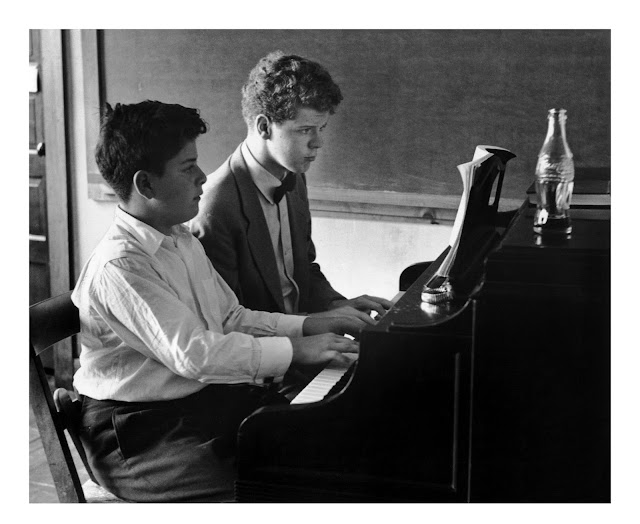
The Young James Levine and Van Cliburn
Marlboro Music Festival Participants
Historic Photo.
 Photographer Clemens  Kalischer


Saturday July 25 and Sunday July 26, 2015 Program Notes:

Saturday
Saariaho - Nymphea
Tessa Lark, Lucy Chapman, John Stulz, and Jonah Ellsworth.
Mozart - Oboe Quartet in F Major, K. 370
Mary Lynch, Yoojin Jang, Daniel Kim, and Judith Serkin.
Mendelssohn - String Quintet in B-flat Major, Op.87
Yoojin Jang, Hiroko Yajima, Wenting Kang, John Stulz, and Will Chow.

Sunday
Beethoven - Piano Trio in C Minor, Op.1, No.3
Mitsuko Uchida, Tessa Lark, and Peter Wiley.
Saariaho - Mirage
Sarah Shafer, Marcy Rosen, and Lydia Brown.
Mozart - String Quintet in G Minor, K.516
Siwoo Kim, Luosha Fang, Daniel Kim, Matthew Lipman, and Peter Wiley.

Danny Kim said it all when he said, “The level of playing is so high and you have so much practice time with other musicians.  It’s a once in a lifetime opportunity to work on a piece of music you love with great musicians.”


Contact: Susan Cloke

For recordings of performances and information about the Festival go to: www.Marlboro.music.org


For more information on Marlboro College go to: https://www.marlboro.edu/

May 29, 2015

What Say You? Diana Gordon: Artist. Lawyer, Activist


Diana Gordon "Red"
photo courtesy of artist

What Say You?  Diana Gordon: Artist, Lawyer, Activist
SUSAN CLOKE
Columnist


“You have to do the work even when it’s not going well,” were Diana Gordon’s words when talking about making art.  “It’s not a sometimes thing.  You have to be disciplined.”

Gordon was speaking about her current show at FIG Gallery, Bergamot Station. http://www.figgallery.com/   She could have been talking about so many parts of her life.

Publicly known in Santa Monica for her involvement in local politics, Gordon was one of the founders of the Coalition for a Livable City  http://www.smclc.net/

“It was my first Council meeting, “ said Gordon talking about her introduction to Santa Monica politics.  “I went to a hearing on the plans for the renovation of Santa Monica Place.  The meeting was long.  Many articulate people spoke.  Yet it felt as if it were a done deal.”

Fast-forward to the present time.  “I think we are at an interesting crossroads in Santa Monica.  The Hines project was a decisive turning point and residents are now organized in a way that makes their voices heard.”

Gordon the political activist is also Gordon the attorney and Gordon the artist.

“My Grandmother was an artist.  She was raised at a time when women were taught to paint on china and paint watercolors as part of their college educations.  It wasn’t until the later years of her life she began painting landscapes.  She painted for the sheer joy of painting.  That fascinated me,” remembered Gordon.

Gordon was also influenced by her mother’s friends,  “My mother had two best friends, one was with a major ad company and the other was a fashion buyer for a major department store in the Midwest.  They had interesting work and I wanted to have interesting work too.

“As a UCLA student I studied history, Spanish and art.  When I was a Junior I did a Year Abroad in Madrid.  I studied at the Prado and saw for myself the worlds created by artist such as Goya and Bosch.  Having grown up in the San Fernando Valley the artists I studied at the Prado were a revelation.”

Being a painter herself was in her future, but Gordon didn’t know it yet.  She graduated UCLA with a major in history and went on to law school at UC Davis.

“I liked being a lawyer,” said Gordon.  “I went into the field of business and entertainment litigation and practiced law for most of my adult life.  I only began transitioning to being an artist in the last 12 years.”

In 2003 Gordon inherited a treasure trove of paints and art materials and books about art.  It seemed the inheritance came at just the right time in her life.  Gordon began to study with the artist Martin Lubner at his studio in Venice, CA.

“Abstract art interests me because it is a nonverbal language and it requires an emotional understanding whereas with figurative art our minds recognize the object.  How color works in the service of other color, the diversity, the range and the dialogue of color fascinates me,” said Gordon.

“The process of painting is, for me, like being a lawyer.  You are always working to marshal ideas and winnowing down to the strongest possible statement, said Gordon.  “Everything that you’re passionate about in your life makes your life and your work better.”

What Say You?


The show at the Bergamot Station FIG Gallery, Will to Form, is Gordon’s first solo show.  The opening reception is May 30.  The show closes June 27.


April 24, 2015

The “Big Three” Santa Monica Construction Projects

California Incline detours that are now in effect through Spring 2016.
GRAPHIC COURTESY CITY OF SANTA MONICA
California Incline detours that are now in effect through Spring 2016.

The “Big Three” Santa Monica Construction Projects

The future Colorado Esplanade looking west on Colorado Ave. with the Pier sign in the distance. From left to right the image shows the new pedestrian walkway, the new bike lanes, the road divider, and the westbound vehicle lanes.
COURTESY PHOTO
The future Colorado Esplanade looking west on Colorado Ave. with the Pier sign in the distance. From left to right the image shows the new pedestrian walkway, the new bike lanes, the road divider, and the westbound vehicle lanes.
Sunset Trail Pedestrian Path.
PHOTO CREDIT WATER AND POWER ASSOCIATION
Sunset Trail Pedestrian Path.
The California Incline closed to traffic on Monday, April 20. I made the circuit of the “Big Three,” the three construction projects that have Santa Monicans talking about traffic. Walking from the under construction light rail station at 4th and Colorado, along the under construction Colorado Esplanade, and up Ocean Avenue to the under construction California Incline. All three projects have an estimated end date of Spring 2016.
At mid-morning the Colorado Esplanade was busy with people walking to the Pier and the Park and Downtown and with cars on the westbound only lanes. At the California Incline, PCH and Ocean Ave. were relatively quiet with cars moving normally and people in the park walking and jogging, sitting on the benches, leaning on the fence, and watching the ocean.
The word on the street had Santa Monica in a mad traffic snarl because of the closure of the California Incline. But it seems drivers had gotten the word to find alternate routes. Perhaps enough drivers had found alternate routes to account for the easier than usual Ocean Ave. traffic.
Why three construction projects at once? Why build during the high tourist summer months? Why start the California Incline before the PCH sewer work is complete?
Interim City Manager Elaine Polachek talked about the reasons why the California Incline project was starting now.
“The California Incline Bridge is substandard, meeting only 30 percent of the standards used to evaluate the structural integrity of the bridge. A lot has changed since 1930 when this bridge was built,” Polachek said.
“No matter when we start it will take a year to complete the project even though it’s a fast-track project. We timed it so only one summer season will be affected by construction.”
“We had been told that the PCH sewer construction project would be completed before the California Incline project start date. Unfortunately that didn’t happen. Although we have now been told that it will be completed by June.
“We will be continually responding to daily problems and events and will be tweaking details as things happen to make this as smooth as possible.”
Originally called the “Sunset Trail” the wood fenced path led from Palisades Park to the beach. Wikipedia lists the trail as being built in 1896 and replaced in 1930 and in continuous use until today’s closure.
“Bringing the California Incline to current seismic standards is the reason for this project. We’ve been working on this project for a long time to secure funding and to receive all the approvals necessary to meet the Federal and State standards. Ninety percent of the $20 million cost of the project will be federally funded,” said Susan Cline, Interim Director of Public Works for the City.
“Once the resources and approvals were secured we moved forward as quickly as we could on this project because it is in the interest of public safety.
“The new bridge will be 52 feet wide. There will be two vehicle lanes, two bicycle lanes and a pedestrian walkway. The iconic design of the fence will be maintained.”
The California Incline is on its own schedule, determined by public safety and by guidelines that come with the Federal funding. The two other big construction projects, the light rail station, run by Expo, and the City run Colorado Esplanade are being coordinated so that the Esplanade is ready when the first passengers get off the light rail train at the 4th Street Station.
“The Colorado Esplanade is designed to be an extension of the light rail, a gateway to the downtown, the Pier and Palisades Park,” said Cline.
At a cost of $13 million the Esplanade is funded by a combination of city general funds, federal funds and special revenue funds. The idea behind the Esplanade design was to make it easier and more fun to walk and bike than to drive.
The 6.6 mile light rail line currently under construction will extend Expo from Culver City to Santa Monica. Expo projects that, by 2030, there will be 64,000 people who ride the Expo line along the Downtown Los Angeles/Santa Monica route. The total cost of the line is estimated at $1.5 billion.
For now plan your detours and your alternate routes. But hold on to the thought that 64,000 Expo riders overall will translate into thousands fewer people coming to Santa Monica in cars and easier trips to downtown LA for Santa Monicans. Hold on to knowing that the California Incline will not fall down in an earthquake.
It’s early times, and there are and will be many problems that need to be solved so people can get where they need to go. But in a year maybe there will be a party celebrating the end of construction on the “Big Three” and the reason will be more people walking and biking and people in cars having a much easier time of it.
What Say You?
City project information: www.smconstructs.org
Esplanade Hotline: 626.344.4248
Incline Hotline: 888.303.6026

March 28, 2015

What Say You? Post Office Dreaming

The former Santa Monica post office at the corner of 5th and Arizona.
U.S. Post Office Santa Monica CA  Fifth Street and Arizona Avenue
Closed 2013


Post Office Dreaming
SUSAN CLOKE
Columnist
March 27, 2015


Wonderful mailman and mailwoman stories are the norm in Santa Monica.  But post office stories are of long lines, waiting until it’s your turn and then having the person close for an unexplained reason, counter clerks who often look as if being behind the counter is forced labor.  Hard parking next to an industrial issue building adds to the many reasons people keep turning to other choices, more convenient choices, even if they are more costly.

To be fair to the Post Office, they were put in a financial vise by Congressional regulations that single them out for budget failure.  The USPS is fighting for its very existence.  But is it making the best decisions to win that fight?

Karl Frish wrote, in September of 2011, on Huffington Post,I guess no one ever thought it would be the Republican Party finishing off the Postal Service... The power to create post offices is enumerated in our Constitution. Our Postal Service is even fully funded by the sale of stamps, not through tax dollars. That is a combo that should bring tears of joy to the eyes of tea partiers and Republicans alike.”

The Postal Accountability Enhancement Act (PAEA) was a creation of the Republican controlled 2006 Congress with California Republican Darrell Issa leading the charge. https://www.govtrack.us/congress/bills/109/hr6407/text

The Act mandates a prepayment on the health care benefits for all postal workers for 75 years into the future.  No other government agency has been required to do the same.  This Act forced the USPS into the red.

As part of a plan to raise money the USPS decided to sell off valuable historic properties.  This decision was made against the protest of Historic Preservationists in communities across the United States.  Santa Monica’s New Deal era Art Deco post office on 5th and Arizona was one of many that was lost to the American people due to the budget dictates of PAEA.

“I think they got it wrong,” Congressman Waxman was quoted as saying about the sale of the Santa Monica Post Office in the NYT 3.7.2013. “It’s a Depression-era structure, it’s an historic structure, one of the few Art Deco buildings in Santa Monica.”

Santa Monica Conservancy President Carol Lemlein said, “The Santa Monica post office on 5th and Arizona was worth more to the USPS as a property asset than as a working post office.  The issue was to raise money by selling property.  It was part of a strategy employed by the USPS and many historic post office buildings across the country were sold.

“The Santa Monica Post Office building was purchased by Skydance Productions and the Conservancy has been in discussions with them as they have committed to preserving the building and restoring historic features of the lobby,” said Lemlein.  “As a result of work by the Landmarks Commission and the Conservancy they were required to sign a Covenant to protect the building and the lobby.  I’m optimistic that they will do well by the building.”

It’s a loss to the communities of their historic buildings either by demolition or because they will no longer be buildings for public use even if they are preserved by private companies. But it’s only part of an ongoing struggle for the USPS. 

Ruth Goldway, a former Santa Monica Mayor, and a past Member of the Postal Regulatory Commission took the USPS to task for further cuts for which other options had been identified.

In the January 13, 2015 issue of The Hill she wrote:  “While we have experienced increased access to electronic communications options, particularly in metropolitan areas, a great many American homes and businesses rely upon the mail.  It remains essential that all Americans can rely on a fundamental communication service and avenue of commerce that provides equal access and prompt service to all, regardless of region. Binding the nation together is the founding principle of the Postal Service’s mandate. 
Goldway served on the Postal Regulatory Commission from 1998 and Chaired the Commission from 2009 to 2014, at the time of the closing of the Santa Monica Post Office.

Post offices in historic buildings in small towns across the Country offer welcoming lobbies and helpful postmasters and postal clerks who have found ways to make the post office a place people want to come; to get their mail, to sit and talk, to get the news of their neighbors and the town.

The future of our venerable postal service is in jeopardy.  A business plan that made each post office a place people wanted to be would go a long way toward building a constituency for the USPS.  A business plan that made each post office central to the fabric of the community and listened to the community served seems to me to be essential for protecting the future of the USPS.

It’s not the whole answer but it’s an important part of the answer.  USPS are you listening?


February 21, 2015

What Say You. Yousef Bittar An American Muslim

More than 1000 Norwegian Muslims form a 'Ring of Peace' around an Oslo synagogue after the terrorist attacks in Copenhagen and Paris.
PHOTO VIA WOCHIT
More than 1000 Norwegian Muslims form a 'Ring of Peace' around an Oslo synagogue after the terrorist attacks in Copenhagen and Paris.
What Say You? Yousef Bittar: An American Muslim 
Santa Monica resident Yousef Bittar immigrated to the U.S. in 2001 from Saudi Arabia.
PHOTO BY SUSAN CLOKE
Santa Monica resident Yousef Bittar immigrated to the U.S. in 2001 from Saudi Arabia.
SUSAN CLOKE
Columnist
Santa Monica Mirror
February 27, 2015

“Chanting ‘No to anti-Semitism, no to Islamophobia,’ Norway’s Muslims formed what they called a ring of peace a week after Omar Abdel Hamid El-Hussein, a Danish-born son of Palestinian immigrants, killed two people at a synagogue and an event promoting free speech in Copenhagen last weekend,” the New York Times published on Feb. 21.
If Yousef Bittar had moved from Saudi Arabia to Norway instead of moving to the United States in 2001, he would have been one of the Muslims defending the synagogue. Bittar was born in 1984 at the Dar Al Shifaa (House of Healing) Hospital in Damascus, Syria. The oldest of three children born to parents who were both doctors, he grew up in Damascus and Riyadh, Saudi Arabia. Bittar came to the U.S. as a student in 2001.
Now a resident of Santa Monica, this is his story. And because history pays attention to each of us, whether or not we are interested in it, it is also a way into thinking about the large geopolitical problems of our own time.
“As a child in Damascus I often saw my mother, when she was not going to her work as a doctor, wearing slacks. Women weren’t required to wear the hijab (the traditional Muslim women’s headscarf) but my mom chose to. Damascus looked then very much like a contemporary western city,” Bittar said.
“There were freedoms in many areas of life but none in political life. Assad was the President but he acted like a dictator. People were afraid to criticize Assad.
“As a child I made a joke about him in school and the joke was reported to the Principal who said that I needed to be punished. She warned that the next day the soles of my feet would be beaten with a cane in front of everybody so that everyone could learn a lesson from what I had done. I came to school the next day wearing three pairs of socks. But the beating never took place and I never knew why I was saved. What I did learn is that it was a great life in Syria as long as you stay out of politics.
“I played soccer on the streets with my friends. Our school gave us a good education in the sciences, math, language. We all studied English. My parents’ generation spoke French.
“Damascus was a predominately Muslim city and we could hear the Izan (the call to prayer) all over the city. My father would take us to the Mosque on Fridays. Sometimes my mother would come. Sometimes she would choose to pray at home.
“When I was nine my mom got a new job in Saudi Arabia. When she got to Riyadh she had a terrible experience. One she completely didn’t expect. She was walking down the street wearing her regular work clothes and the official religious police stopped her. They had big beards and wore long white robes. They traveled in GMC cars with blacked out windows. They took her to a shopping mall and made her buy an abaya (a cloth that covers the hair and the entire body) and told her she had to wear it at all times.”
It was a story that upset Bittar.
However, it was in Saudi Arabia that he got a chance to go to International School. Bittar was 14. He said, “The school was taught entirely in English and one of my teachers was from Los Angeles and I really liked her class.”
In June of 2001 Bittar came to the United States to study. His father had come with him to help him get settled in Chicago.
“My parents were both doctors and my uncles were both doctors and my father wanted me to be a doctor. It was hard,” said Bittar. “I was 17 and I had come from a close family and from the culture of Saudi Arabia to the United States and it was really culture shock. Nobody cared what I did. No one was watching. Not my family and not my neighbors. At the same time I felt like I had escaped and I felt like I could be happy.
“I did really well in school and I made a lot of friends in college and with my neighbors. My neighbors took me to church with them. I am Muslim but I wanted to learn about their religion and customs. I worked at the Subway sandwich shop and made friends with the other kids who worked there.
“Then 9/11 happened and no one would talk to me anymore. I so remember seeing three teenagers standing on the sidewalk and waving a big American flag. People going by in their cars were honking in support of them. I asked if I could join them and they said, ‘yes.’ We were having a great time talking and waving at people as they went by and honked at us. Then one of them asked, ‘where are you from?’ When I said I was from Saudi Arabia they took the flag away from me and I left.
“My dad definitely wanted me to have the life I could only have if I came to the United States. He didn’t have the opportunity to come here though there was a part of him that wanted that very much. So he made it possible for me to leave home, to live far away from my family and to make my future in the United States.
“Amazingly I was learning that it was okay to be different. That this is really a melting pot of people from all over the world and I began to feel if this person can be accepted so can I.
“Here in the U.S. the question American parents ask their children is, ‘what do you want to be?’ In my family that wasn’t the case. I got upset and left my studies for a while. I finally graduated. My degree was in biology and chemistry, as my family wished.
“It was 2008. I knew I didn’t want to be a doctor. It was a bad economy then and it took me months to find a job. My first job was at a bank in Mount Prospect in Chicago. I loved working there. I think I grew up professionally in the bank.
“In 2013 a really good branch of the bank I worked for offered me a job in Santa Monica. I didn’t know what it would be like to live in Santa Monica but I took the job.
“Moving was much tougher than I had realized. You have to make new friends, leave old friends, get acquainted with a new city, learn a new job. 2013 was a rough year.
“By 2014 I was having a good year professionally and I had amazing experiences meetings all kinds of people at work and in Santa Monica. Now it’s 2015 and all I can say is that you never know the future.”
Yousef Bittar is a success story, both in his professional and in his personal life. The kind of story we want for all our children. The details are different, but doesn’t it sound like an emotionally familiar journey to being an adult?
It’s not that there haven’t been hard things in Bittar’s life. Hard for him is the violence done in the name of Islam. Bittar is angry and firm when he states, “terrorists have no place in Islam. It is not Islam who is the executioner; it is the man who is doing the terrible act who is the murderer.
Bittar said, “Hope comes because the culture in the Middle East has started changing in the last 15 years. Globalization and social media and websites and the Internet have transformed the way people act and think.
“Then I see the violence of these terrorists who came out of seemingly nowhere and have set the Middle East back centuries. Any person can figure out what these people are doing is wrong.
“What matters to me is not the religion or the race or the sex. What matters to me is are you treating me with kindness and respect, with honesty. That is what is important to me and anything else is irrelevant,” said Bittar.
What matters to Yousef Bittar is what matters to all of us. Those same values motivated the more than 1,000 Muslims in Norway who formed a “Ring of Peace” around a Jewish synagogue in Oslo on Saturday, Feb. 21.
Those same values motivated the making of the 2013 documentary film, “Honor Diaries,” telling the stories of nine human rights activists who expose the cruel horror of “honor killings.” --https://www.youtube.com/user/honordiaries
In Paris millions of people demonstrated in support of the values of liberty and equality and as a protest against the murders at the offices of Charlie Hebdo and the kosher market in Paris. --http://www.theguardian.com/world/gallery/2015/jan/08/demonstrations-of-solidarity-after-charlie-hebdo-attacks-in-pictures
The terrorists in Paris had shouted “Allahu Akbar” (Arabic for “God is Great”) as they were murdering people. In Yousef Bittar’s words, “They try to justify the evil inside them. The easiest way for them to justify their evil deeds is to say it is in the name of religion.”
There are over 1.5 billion Muslims in the world. If Islam really were a terrorist religion we wouldn’t have much of a chance. Mobs and thugs have hijacked the name of Islam.
For protection from terrorists we look to our government and our military men and women. For our future and our children’s future we must find the way to a world without terrorists.
What Say You?

February 6, 2015

Hometown Heroes: Medicine and Art

Hometown Heroes: Medicine and Art
Richard Willis.  Daniela Schweitzer.  Lou D’Elia
SUSAN CLOKE
Columnist


The Joy of Being Read To
Artist Richard Willis


The Joy of Being Read To, Turn the Page and Shhh are the titles of three of the sculptures on display at the Essentia showroom and Art Gallery at 2430 Main Street in Ocean Park.

Whimsical and witty, romantic and philosophical, the sculptures are displayed in the windows capturing the attention of passers-by and bringing them into the Essentia showroom. 

The sculptures are the work of longtime Ocean Park neighborhood dentist, Dick Willis.  From the late 1970’s on, Willis, who lived in Ocean Park with his wife Cecile and sons Aaron and Joe, walked every day to his Main Street dental office.

Shhh
Door Knocker
Artist Richard Willis
The Willis’ still live in Ocean Park, their sons are grown.  The dental practice was sold and Willis is now an artist.
Turning the Page
Artist Richard Willis


Workers Carrying Buckets
Artist Daniela Schweitzer

The once bare white walls of the Essentia showroom  display paintings that burst with color and energy, landscapes of place and emotion.

Images of dancers, workers, people talking, show us life in Central And South America and are the work of Daniela Schweitzer who is a Clinical Genticist at Children's Hospital in Los Angeles and an artist.


Fast Milonga
Artist Daniela Schweitzer

 For several years Lou D’Elia and his partner, the architect Mike Salazar, walked by the Essentia showroom on Main Street and wondered about the large and bare space with some mattresses on display.  They never saw anyone in the showroom. 


It was D’Elia’s background in art and his appreciation for other artists that drew him into the Essentia showroom on a day when he say people inside.   


It was a moment of serendipity.  D’Elia met the owner, a Canadian with only a few showrooms in the U.S., and they talked art.

D’Elia told the owner, “It’s a gorgeous store and it looks like a gallery space.  If you would agree to my putting up art shows here I think it would be good for the artists and bring more people into the store.”   

D’Elia, the third medical person in this story, is a neuropsychologist who was formerly on the faculty at the Geffen School of Medicine at UCLA and is continuing his work now as a consultant to neurologists assisting in assessing the cognitive functioning capabilities of their patients.  He is also an assemblage artist. “Getting older,” said D’Elia, who will be 64 in March,  “I want to go more fully into being an artist.”

Willis, Schweitzer and D’Elia also share an interest and a curiosity about the larger world, a focus on their own community and a commitment to family and friends. 

Dick and Cecile Willis took an around the world trip in 1971 and 1972, experiencing the beauty of the Taj Mahal, the extreme poverty of India, a visit to a then very peaceful Afghanistan and to a modern Iran.  They saw ancient art and Sufis and whirling dervishes and went to shops in caves.

Willis said they felt welcome everywhere they went.  But they came back to Ocean Park to live.

Lou D’Elia, born and raised in Ocean Park, is a history buff.  He is the custodian of the estate of Pancho Barnes and the archivist of the Pancho Barnes papers, he and Salazar are the owners and preservationists of an Ocean Park Cultural Landmark house, and a classic car aficionado who organizes a 3rd Tuesdays classic car night as part of Food Truck Tuesdays in Ocean Park.

Daniela Schweitzer, born in Argentina, has studied art since she was a child.  She studied medicine in Argentina.  As part of her studies she came to UCLA for a residency and met the man who would become her husband, Tom Rothenbucher, on the Big Blue Bus.

Moving to the U.S. meant redoing all her medical certifications.  While she was meeting all the requirements for practicing medicine in the U.S. she also volunteered on art programs at her daughter Natasha’s school and supported art in the community. 

Being an artist reemerged as a central focus in her life only about three years ago.  Inspired by the landscape of the ocean and by Natasha’s study of dance Schweitzer joined an artists’ group and began painting again.

Getting older seems to the common denominator to a boom of art making and community building in Santa Monica.  Or maybe just a continuum of the high energy of Santa Monica with its amazing history of art and artists, creativity and leadership.

Three different patterns of life, but all informed by curiosity and generosity. These three people, like so many Santa Monicans, have used their gifts to create meaning in their own lives and to be builders of our shared community.