February 21, 2015

What Say You. Yousef Bittar An American Muslim

More than 1000 Norwegian Muslims form a 'Ring of Peace' around an Oslo synagogue after the terrorist attacks in Copenhagen and Paris.
PHOTO VIA WOCHIT
More than 1000 Norwegian Muslims form a 'Ring of Peace' around an Oslo synagogue after the terrorist attacks in Copenhagen and Paris.
What Say You? Yousef Bittar: An American Muslim 
Santa Monica resident Yousef Bittar immigrated to the U.S. in 2001 from Saudi Arabia.
PHOTO BY SUSAN CLOKE
Santa Monica resident Yousef Bittar immigrated to the U.S. in 2001 from Saudi Arabia.
SUSAN CLOKE
Columnist
Santa Monica Mirror
February 27, 2015

“Chanting ‘No to anti-Semitism, no to Islamophobia,’ Norway’s Muslims formed what they called a ring of peace a week after Omar Abdel Hamid El-Hussein, a Danish-born son of Palestinian immigrants, killed two people at a synagogue and an event promoting free speech in Copenhagen last weekend,” the New York Times published on Feb. 21.
If Yousef Bittar had moved from Saudi Arabia to Norway instead of moving to the United States in 2001, he would have been one of the Muslims defending the synagogue. Bittar was born in 1984 at the Dar Al Shifaa (House of Healing) Hospital in Damascus, Syria. The oldest of three children born to parents who were both doctors, he grew up in Damascus and Riyadh, Saudi Arabia. Bittar came to the U.S. as a student in 2001.
Now a resident of Santa Monica, this is his story. And because history pays attention to each of us, whether or not we are interested in it, it is also a way into thinking about the large geopolitical problems of our own time.
“As a child in Damascus I often saw my mother, when she was not going to her work as a doctor, wearing slacks. Women weren’t required to wear the hijab (the traditional Muslim women’s headscarf) but my mom chose to. Damascus looked then very much like a contemporary western city,” Bittar said.
“There were freedoms in many areas of life but none in political life. Assad was the President but he acted like a dictator. People were afraid to criticize Assad.
“As a child I made a joke about him in school and the joke was reported to the Principal who said that I needed to be punished. She warned that the next day the soles of my feet would be beaten with a cane in front of everybody so that everyone could learn a lesson from what I had done. I came to school the next day wearing three pairs of socks. But the beating never took place and I never knew why I was saved. What I did learn is that it was a great life in Syria as long as you stay out of politics.
“I played soccer on the streets with my friends. Our school gave us a good education in the sciences, math, language. We all studied English. My parents’ generation spoke French.
“Damascus was a predominately Muslim city and we could hear the Izan (the call to prayer) all over the city. My father would take us to the Mosque on Fridays. Sometimes my mother would come. Sometimes she would choose to pray at home.
“When I was nine my mom got a new job in Saudi Arabia. When she got to Riyadh she had a terrible experience. One she completely didn’t expect. She was walking down the street wearing her regular work clothes and the official religious police stopped her. They had big beards and wore long white robes. They traveled in GMC cars with blacked out windows. They took her to a shopping mall and made her buy an abaya (a cloth that covers the hair and the entire body) and told her she had to wear it at all times.”
It was a story that upset Bittar.
However, it was in Saudi Arabia that he got a chance to go to International School. Bittar was 14. He said, “The school was taught entirely in English and one of my teachers was from Los Angeles and I really liked her class.”
In June of 2001 Bittar came to the United States to study. His father had come with him to help him get settled in Chicago.
“My parents were both doctors and my uncles were both doctors and my father wanted me to be a doctor. It was hard,” said Bittar. “I was 17 and I had come from a close family and from the culture of Saudi Arabia to the United States and it was really culture shock. Nobody cared what I did. No one was watching. Not my family and not my neighbors. At the same time I felt like I had escaped and I felt like I could be happy.
“I did really well in school and I made a lot of friends in college and with my neighbors. My neighbors took me to church with them. I am Muslim but I wanted to learn about their religion and customs. I worked at the Subway sandwich shop and made friends with the other kids who worked there.
“Then 9/11 happened and no one would talk to me anymore. I so remember seeing three teenagers standing on the sidewalk and waving a big American flag. People going by in their cars were honking in support of them. I asked if I could join them and they said, ‘yes.’ We were having a great time talking and waving at people as they went by and honked at us. Then one of them asked, ‘where are you from?’ When I said I was from Saudi Arabia they took the flag away from me and I left.
“My dad definitely wanted me to have the life I could only have if I came to the United States. He didn’t have the opportunity to come here though there was a part of him that wanted that very much. So he made it possible for me to leave home, to live far away from my family and to make my future in the United States.
“Amazingly I was learning that it was okay to be different. That this is really a melting pot of people from all over the world and I began to feel if this person can be accepted so can I.
“Here in the U.S. the question American parents ask their children is, ‘what do you want to be?’ In my family that wasn’t the case. I got upset and left my studies for a while. I finally graduated. My degree was in biology and chemistry, as my family wished.
“It was 2008. I knew I didn’t want to be a doctor. It was a bad economy then and it took me months to find a job. My first job was at a bank in Mount Prospect in Chicago. I loved working there. I think I grew up professionally in the bank.
“In 2013 a really good branch of the bank I worked for offered me a job in Santa Monica. I didn’t know what it would be like to live in Santa Monica but I took the job.
“Moving was much tougher than I had realized. You have to make new friends, leave old friends, get acquainted with a new city, learn a new job. 2013 was a rough year.
“By 2014 I was having a good year professionally and I had amazing experiences meetings all kinds of people at work and in Santa Monica. Now it’s 2015 and all I can say is that you never know the future.”
Yousef Bittar is a success story, both in his professional and in his personal life. The kind of story we want for all our children. The details are different, but doesn’t it sound like an emotionally familiar journey to being an adult?
It’s not that there haven’t been hard things in Bittar’s life. Hard for him is the violence done in the name of Islam. Bittar is angry and firm when he states, “terrorists have no place in Islam. It is not Islam who is the executioner; it is the man who is doing the terrible act who is the murderer.
Bittar said, “Hope comes because the culture in the Middle East has started changing in the last 15 years. Globalization and social media and websites and the Internet have transformed the way people act and think.
“Then I see the violence of these terrorists who came out of seemingly nowhere and have set the Middle East back centuries. Any person can figure out what these people are doing is wrong.
“What matters to me is not the religion or the race or the sex. What matters to me is are you treating me with kindness and respect, with honesty. That is what is important to me and anything else is irrelevant,” said Bittar.
What matters to Yousef Bittar is what matters to all of us. Those same values motivated the more than 1,000 Muslims in Norway who formed a “Ring of Peace” around a Jewish synagogue in Oslo on Saturday, Feb. 21.
Those same values motivated the making of the 2013 documentary film, “Honor Diaries,” telling the stories of nine human rights activists who expose the cruel horror of “honor killings.” --https://www.youtube.com/user/honordiaries
In Paris millions of people demonstrated in support of the values of liberty and equality and as a protest against the murders at the offices of Charlie Hebdo and the kosher market in Paris. --http://www.theguardian.com/world/gallery/2015/jan/08/demonstrations-of-solidarity-after-charlie-hebdo-attacks-in-pictures
The terrorists in Paris had shouted “Allahu Akbar” (Arabic for “God is Great”) as they were murdering people. In Yousef Bittar’s words, “They try to justify the evil inside them. The easiest way for them to justify their evil deeds is to say it is in the name of religion.”
There are over 1.5 billion Muslims in the world. If Islam really were a terrorist religion we wouldn’t have much of a chance. Mobs and thugs have hijacked the name of Islam.
For protection from terrorists we look to our government and our military men and women. For our future and our children’s future we must find the way to a world without terrorists.
What Say You?

February 6, 2015

Hometown Heroes: Medicine and Art

Hometown Heroes: Medicine and Art
Richard Willis.  Daniela Schweitzer.  Lou D’Elia
SUSAN CLOKE
Columnist


The Joy of Being Read To
Artist Richard Willis


The Joy of Being Read To, Turn the Page and Shhh are the titles of three of the sculptures on display at the Essentia showroom and Art Gallery at 2430 Main Street in Ocean Park.

Whimsical and witty, romantic and philosophical, the sculptures are displayed in the windows capturing the attention of passers-by and bringing them into the Essentia showroom. 

The sculptures are the work of longtime Ocean Park neighborhood dentist, Dick Willis.  From the late 1970’s on, Willis, who lived in Ocean Park with his wife Cecile and sons Aaron and Joe, walked every day to his Main Street dental office.

Shhh
Door Knocker
Artist Richard Willis
The Willis’ still live in Ocean Park, their sons are grown.  The dental practice was sold and Willis is now an artist.
Turning the Page
Artist Richard Willis


Workers Carrying Buckets
Artist Daniela Schweitzer

The once bare white walls of the Essentia showroom  display paintings that burst with color and energy, landscapes of place and emotion.

Images of dancers, workers, people talking, show us life in Central And South America and are the work of Daniela Schweitzer who is a Clinical Genticist at Children's Hospital in Los Angeles and an artist.


Fast Milonga
Artist Daniela Schweitzer

 For several years Lou D’Elia and his partner, the architect Mike Salazar, walked by the Essentia showroom on Main Street and wondered about the large and bare space with some mattresses on display.  They never saw anyone in the showroom. 


It was D’Elia’s background in art and his appreciation for other artists that drew him into the Essentia showroom on a day when he say people inside.   


It was a moment of serendipity.  D’Elia met the owner, a Canadian with only a few showrooms in the U.S., and they talked art.

D’Elia told the owner, “It’s a gorgeous store and it looks like a gallery space.  If you would agree to my putting up art shows here I think it would be good for the artists and bring more people into the store.”   

D’Elia, the third medical person in this story, is a neuropsychologist who was formerly on the faculty at the Geffen School of Medicine at UCLA and is continuing his work now as a consultant to neurologists assisting in assessing the cognitive functioning capabilities of their patients.  He is also an assemblage artist. “Getting older,” said D’Elia, who will be 64 in March,  “I want to go more fully into being an artist.”

Willis, Schweitzer and D’Elia also share an interest and a curiosity about the larger world, a focus on their own community and a commitment to family and friends. 

Dick and Cecile Willis took an around the world trip in 1971 and 1972, experiencing the beauty of the Taj Mahal, the extreme poverty of India, a visit to a then very peaceful Afghanistan and to a modern Iran.  They saw ancient art and Sufis and whirling dervishes and went to shops in caves.

Willis said they felt welcome everywhere they went.  But they came back to Ocean Park to live.

Lou D’Elia, born and raised in Ocean Park, is a history buff.  He is the custodian of the estate of Pancho Barnes and the archivist of the Pancho Barnes papers, he and Salazar are the owners and preservationists of an Ocean Park Cultural Landmark house, and a classic car aficionado who organizes a 3rd Tuesdays classic car night as part of Food Truck Tuesdays in Ocean Park.

Daniela Schweitzer, born in Argentina, has studied art since she was a child.  She studied medicine in Argentina.  As part of her studies she came to UCLA for a residency and met the man who would become her husband, Tom Rothenbucher, on the Big Blue Bus.

Moving to the U.S. meant redoing all her medical certifications.  While she was meeting all the requirements for practicing medicine in the U.S. she also volunteered on art programs at her daughter Natasha’s school and supported art in the community. 

Being an artist reemerged as a central focus in her life only about three years ago.  Inspired by the landscape of the ocean and by Natasha’s study of dance Schweitzer joined an artists’ group and began painting again.

Getting older seems to the common denominator to a boom of art making and community building in Santa Monica.  Or maybe just a continuum of the high energy of Santa Monica with its amazing history of art and artists, creativity and leadership.

Three different patterns of life, but all informed by curiosity and generosity. These three people, like so many Santa Monicans, have used their gifts to create meaning in their own lives and to be builders of our shared community.


January 15, 2015

Charlie Hebdo. "Je Suis Charlie"

What Say You?  Charlie Hebdo
SUSAN CLOKE
Columnist
January 15, 2015

Charlie Hebdo, the French satirical magazine, published the issue dubbed as “The Surviors’ Issue” on January 14.  The cover is a cartoon of the Prophet Muhammad, a tear in his eye, carrying a “Je suis Charlie” sign.  The caption above reads, “All is forgiven.”

Charlie Hebdo
The Survivor's Issue


Sadly the magazine Charlie Hebdo is known now to the whole world because of the terrorists attacks of January 7 in Paris. 11 members of the magazine staff, a policeman and 4 people in a kosher market were murdered by crazed gunmen shouting “Allahu Akbar” which translates “God is great.”

Charlie Hebdo is wildly famous in France.  The cartoonists who died were household names with star status.  The magazine carried on the French tradition of irreverent satire that doesn’t have a parallel in the U.S.

On January 11, more than a million people took to the streets of Paris to demonstrate their support for the French principals of “Liberte, Egalite, Fraternite,” to condemn the violence and to support principles of democracy and tolerance.

They wore “Charlie” headbands and carried signs saying “Je suis Charlie.”  (“I am Charlie.”)  President Hollande of France and Chancellor  Merkel of Germany were among the many world leaders present at the march.

In the U.S. the violent and murderous attacks have been everywhere in the news and on the media. Artists and actors, writers and journalists, politicians and community leaders, philosophers and religious leaders have all paid homage to the people who were killed in France and have tried to understand what to do to address the violence and protect democratic freedoms.

At the same time, as reported in the New York Times, the response had been mixed in Muslim Countries.

“Al-Azhar University, the foremost institution of Sunni scholarship, on Wednesday called on people to “ignore” the cartoons. “Ignore this unpleasant trifle,” the statement advised, “because the Prophet of mercy and humanity (peace be upon him) is on too great and high a level to be affected by drawings that lack ethics.”

“The Egyptian Family House, an organization of the country’s main Muslim and Coptic Christian authorities, issued a statement decrying the cartoons because they “increase the gap between people and religions” and calling on media outlets not to “negatively target the prophets and the heavenly religions, and not to provoke the feelings of Muslims.”

“Egyptian courts have recently sentenced a 21-year-old student to three years in jail for atheism and what were deemed blasphemous statements on his Facebook page, and a Christian man was sentenced last year to six years for “insulting Islam.”

 “Insulting the prophet can never be regarded within the context of media freedom,” Ercan Ezgin, a Turkish lawyer, wrote in the complaint that prompted the ruling in Diyarbakir, according to the CNN Turk channel. “This cartoon bears the danger of deeply provoking billions of Muslims. It should never be acceptable to depict our prophet in such a cartoon, poking fun at him, showing him as if he’s shedding tears.”

“But one Turkish website, T24, translated the entire new issue of Charlie Hebdo into Turkish and those pages were still accessible Wednesday evening.

“Hezbollah, the Lebanese Shiite group whose leader, Hassan Nasrallah, last week criticized extremists who kill those they consider infidels in the name of Islam — without explicitly denouncing the Paris killings — released a statement Wednesday condemning the new cartoon.  “Such an action is absolutely rejected,” it said. He called cartoon “a big provocation to the feelings of more than one and a half billion Muslims in the world, all of them believers in heaven’s messages and keen for dialogue and common values. Such actions directly contribute to supporting terrorism, extremism and extremists.”

“The Islamic State militant group – to which one of the Paris attackers swore allegiance — declared on its Internet radio channel: “In a very idiotic move, Charlie Hebdo published in new edition an offensive drawing of the greatest prophet, peace be upon him. The atheist journal is seeking to exploit the recent events to gain more money with today’s edition.”

“Syria’s president, Bashar al-Assad, said in comments published Wednesday in a Czech newspaper that the attacks in Paris were a result of Western support for “terrorism,” referring to Western backing of insurgents opposed to his rule.”

“We are against the killing of innocent people anywhere in the world,” Mr. Assad said, drawing anger and ridicule from Syrians opposed to his rule, who noted that his government has killed countless Syrians in indiscriminate bombardments during four years of civil war that have left more than 200,000 dead.

In an essay in Politico, Hisham Melhem, the Washington bureau chief of Al Arabiya, the Saudi-owned pan-Arabic news channel, sought to explain why there was little groundswell of interest.

“Western politicians and scholars anticipating or asking for meaningful political and religious reforms by the nonexistent organized ‘moderates’ in today’s Arab world will be better advised to be patient and bid their time,” he wrote. “Can those living in Baghdad, Aleppo, Sana, and Tripoli — just to name few Arab cities — be blamed if they were not shocked by the killing of the Charlie Hebdo twelve in Paris? Not is only Islam’s religious text being distorted, a whole Arab generation has been totally desensitized by unspeakable violence.”

In Britain, more than 50 prominent Muslim leaders wrote a joint open letterappealing for calm.  “Most Muslims will inevitably be hurt, offended and upset” by the latest cartoon, the letter said. “But our reaction must be a reflection of the teachings of the gentle and merciful character” of Muhammad.


Charlie Hebdo Magazine Cover
July 2013
Anonymous street postings
Pacific Palisades and Brentwood

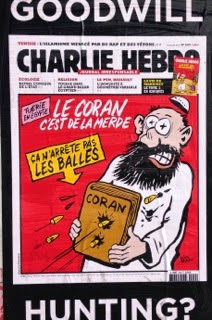
 Just this week, Charlie Hebdo posters were put up in West LA.
Anonymously taped to transformer boxes along Sunset Boulevard and in the Palisades and Brentwood they show a July 2013 Charlie Hebdo magazine cover.   On the cover is a cartoon Muslim holding the “Coran” and a caption that reads in French, “The Coran is shit it can’t stop bullets.”  Added to the surround is the film title, “Good Will Hunting?” with a question mark.
Are the posters in West LA in tribute to Charlie Hebdo?  I think yes.  That leaves me wondering about the addition of “Good Will Hunting” on the borders of the poster. 

The Hollywood blog, the WRAP, thinks the addition may be related to the Ben Affleck/Bill Maher heated and confusing exchange on the Bill Maher show. Or they speculate that the words were added because the film “Good Will Hunting” was co-written by Affleck and Damon.  That Affleck and Damon both live in the area and would see the posters.  But really, that all seems to be quite a stretch.  

What do you think?   If you know the reason for adding the movie title, or have a good guess, please share your information with us. 

What we can and do all share is the profound shock of yet another act of senseless violence.  With each one our world is shaken.  School girls kidnapped.  Elementary school children shot, suicide bombers, torturers.  It’s a list that goes on and on and
with each senseless act of violence so many suffer, so many die, so many lives are condemned to grief.

Yet I take heart from the humanity of a crying Prophet.  From the outrage expressed by Muslims around the world, joining their voices to the outrage expressed in France and really everywhere.

“Nothing Sacred” is a motto at Charlie Hebdo.   Always offending someone through their caricatures and cartoons they also always have a moral point to make. Humor has the magnificent ability to expose deep flaws in humanity and yet to allow us still to hear what is being said.  We usually don’t think of people who can make so many people laugh as being in danger.  But they clearly are.

Charlie Hebdo attorney Richard Malka said, “A good issue of Charlie Hebdo is one that you open, one that frightens you when you see the cartoon, and then makes you laugh out loud.  We won’t give in, otherwise it wouldn’t make any sense.”

What Say You?


December 24, 2014

The Practice of Gratitude


SUSAN CLOKE
Columnist

Gratitude infused the love I felt as I looked around the full Sunday morning brunch table.   I’ve been thinking lately about the value of gratitude in the personal, daily experience of life and about its meaning in human history.

So, when both eating and talking had slowed a little
I turned the discussion at the table to the subject of gratitude.  Asking not only what people were grateful for but also what meaning they assigned to gratitude.

Our three-year-old cousin, the youngest at the table, happily said, “penguin” and held out the adorable stuffed penguin which is her constant companion.

Her eleven year old sister thought and then said, “‘I know I’m able to do cool things other kids can’t.  I go to a great school.  I have understanding and kind people always around me.  I can go swimming.  I go to swim practice every day and that makes me part of a community where I am welcome.”

Our ten year old cousin said, “I’m grateful for nature.  Gratitude is being happy about something.  I’m happy for the things people do for me and I happy to be able to move, to do sports, to run and to play the piano.”

 “I’m grateful to have had such wonderful parents who only wanted me to be happy and were generous to me all their lives,” said their Nana, at 73 the oldest person at the table.

Gratitude became the subject of general conversation and ideas came from everyone, of all ages, bouncing back and forth across the table, starting with “I’m grateful for the Big Bang.” 

“On a daily basis, gratitude is a constant recognition of acts of kindness and generosity.  Recognizing what others do for you.” 

“It feels like being grateful is a luxury.  If you don’t have food you only have one problem and gratitude is a luxury.  If you have food than you have the possibility of having many problems.”

“Imagine the gratefulness our great grandmother must have felt to come to America and live the life she had.” “Sometimes it takes a change in circumstances.”

“I remember being a teenager and coming back from my NOLS
(outdoor education) trip in Utah.  I turned on the faucet and warm water came out.”  That comment got the laughter of recognition.  One of other cousins, in her 40’s, added “like standing in the shower with hot water pouring over you.  It feels like a miracle.”  “It’s like you have to lose something to really understand gratitude.”

“Little things can mean everything.”  “What you do with gratitude – is it a feeling or a practice or both?  Is the practice of gratitude graciousness?”

“If you’re doing something and people are not recognizing it that can be annoying.  So don’t do it for recognition but because it is the right thing to do.”  “Yes, and just feel sorry for the person who can’t feel gratitude.” 

“It’s a shift in perspective that makes you creative.  It’s a consciousness to remember to be grateful when you’re rushing through and doing the normal busy-ness of life and then you realize how wonderful it is to be in this big web of a family.  It’s a rush and makes me feel great and it makes me treasure people.”

Where does gratitude come from?  Why do some people feel it and others not?  Why do some people feel it more than others?

Christmas gives us a special opportunity to think about gratitude.  Christmas is now a commercial holiday and, as such, is as much about giving and getting material objects as it is a religious celebration.  Holidays can be times of joy and fun and they can be times of complicated emotions and relationships.

Don’t get me wrong here.  I love parties and celebrations. I love presents.  I love getting them and I love giving them.  I love the anticipation - especially when I think I’m going to make someone happy.   I’m also very aware that parties and present giving can be emotionally loaded and sometimes cause unhappiness or feelings of debt and obligation.

Before there was a Christmas gratitude was already the subject of philosophers and writers.  Cicero, (b. 106 BCE) the Roman philosopher, orator and theorist said, “Gratitude is not only the greatest of virtues, but the parent of all others.”

Not to be discounted is Piglet, of Winnie the Pooh, who “noticed that even though he had a Very Small Heart, it could hold a rather large amount of Gratitude.” 

Gratitude is at the core of an honorable life and to live without it leaves an emptiness.  It is an outward expression of empathy.  Gratitude is a gift we give and a gift we receive.

Thinking about gratitude together is the gift I hope to share with you this holiday season.

With All Best Holiday and New Year Wishes and with gratitude.


December 12, 2014

What Say You? Water Quality and Santa Monica Water Independence


 "SANTA MONICA WATER.  LOCALLY SOURCED.  BETTER THAN BOTTLED!"
City water is now used at all City meetings and events.
Photo credit Thomas Poon, City Water Resources Department

What Say You?  
Water Quality and Santa Monica Water Independence  
SUSAN CLOKE,
Columnist

Water is the issue.   We are in an extended drought.  The City is focused on water.   Setting and meeting water conservation standards; creating opportunities for public reuse of stormwater through regulations, incentives and rebates; meeting the Council mandated requirement for water self-sufficiency by 2020; and water quality are the goals.

History
Many of us learned our Angelino water history from the Jack Nicholson / Faye Dunaway movie “Chinatown.”  Water wars, and the taking by force of the Owen’s Valley water to satisfy the water needs of the burgeoning city of Los Angeles are the back-story to the growth of the City of Los Angeles.

Santa Monicans have a different history.  In 1917 Santa Monica voted against annexation with Los Angeles even as the City worried about water supplies.

And a very Santa Monica story goes with that vote:  “When an Annexation leader claimed he had had no water in his home the opposition arranged for the fire department to go to his home and record on camera as the fireman took a 100 foot stream of water from the fire hydrant in front of his house.”  (Stella Zadeh)

It didn’t hurt that many Santa Monicans were connected to the new film industry and that they filmed the 100’ stream of water going from the hydrant to the house as part of the anti-annexation campaign.

It was the 1917 vote that kept Santa Monica an independent city.  Now the goal is to achieve water independence.

Currently the City supplies 60 – 65% of its own water needs and buys the rest from the MWD. (Metropolitan Water District) This is a steadily changing number as the City moves toward the 2020 date for water self-sufficiency.

Quality
City water now exceeds the water quality standards set by both the State of CA Department of Drinking Water and the Federal EPA.  This is due to the fact that, as of 2010, City water is treated by reverse osmosis.  Reverse osmosis is a process for cleaning water which forces the water through micron sized pores to capture the smallest molecules of contaminates.

Usage
“Water usage in the City is driven by the commercial sector,” said Gil Borboa, the Water Resources Manager for the City.  “We’re really a small city of fewer than 90,000 residents, but on any given summer day we often have a population of as high as 300,000 people.”

Borbora added, “Every customer, both residential and commercial will be asked to reduce their water usage to 80% of what they used in the same month of 2013.”

Water rationing, as some are labeling it, is “really a misnomer” said Borboa.  “What we have is a proposal for a mandatory 20% reduction in water use from the base year of 2013. This proposal will go to Council in January and start in April, if approved.”

Residential homeowners who have already changed their gardens to water- conserving gardens and reduced their total water use to 22 HFC (hundred cubic feet) or less per billing cycle will not be required to reduce their usage. Usage information is on the City Utilities bill.

Santa Monica also provides grants, rebates and incentives to help homeowners convert to water conserving gardens and to the use of cisterns and other stormwater capture and reuse devices.   www.smgov.net/water

“Conservation is only part of the answer,” said Borboa.  “We also need to increase our water supply.  Most of our current water supply comes from the Charnock wells.  About 35% is imported Northern CA water bought from the MWD.

“Our current water usage city-wide is about 13,500 Acre Feet. (‘AF’. An AF is 326,000 gallons or the equivalent of a football field covered with 1 foot of water.)  The 2020 demand is anticipated to be approximately 15,490 AF.

Water Independence
 “We are now pumping 9000 AF.  For self-sufficiency we will need an additional 5000 AF of supply and, at the same time, the conservation of 1500 AF.  The 5000 AF will come from three new wells, currently proposed for the Olympic median, and the use of the planned conservation measures,” said Borboa.

 “If we do both we will be able to meet the total gap between what we use and what we need to be able to supply by 2020.

“Our groundwater assessment for the aquifer which supplies Santa Monica shows 300,000 AF of storage in our basins. Basins are recharged by precipitation and deleted by pumping.

“Santa Monica has gone through a series of droughts in its history and we don’t take our groundwater supplies for granted,” said Borboa.

The City is also considering rate increases and is expected to hear the proposed rate increases this December.   “Rate increases are necessary,” said Borboa, “because the Water Resources Agency is funded through the sale of water.  We will need to pay for ongoing operations and maintenance; the replacement of infrastructure built over 50 years ago; running our water treatment plant; digging new wells to meet the goal of water self-sufficiency; and running the water quality lab.

“Water rate increases to be heard by the Council are proposed at 9% for the first year and 13% for each of four subsequent years.”

Santa Monica currently draws its groundwater from the Arcadia, Olympic, and Charnock  basins.  Basins that the City has traditionally used. 

In 1923 the city voted to build the Arcadia plant, to build a five million gallon reservoir at Mount Olivette, and to purchase water-rich land on Charnock Road.

In 1948 Santa Monicans voted to replace the previous mount Olivette reservoir and to fund well construction under the San Vicente median.  In 1958 the City voted for a bond to construct a 25 million gallon reservoir at the Riviera Country Club.

Meeting the Goal
“The continuation of groundwater management in conjunction with conservation and stormwater reuse are all necessary to ensure water self-sufficiency,’ said Borboa, “and we’re well on our way.”

I say, conserve water, plant a stormwater garden, be a steward of the environment.  Drink Santa Monica Water. Here’s to your health! 

What Say You?


November 22, 2014

What Say You? RESIDENTS and THE ZONING ORDINANCE


What Say You?  RESIDENTS and THE ZONING ORDINANCE
SUSAN CLOKE
Columnist


The Planning Commission, concerned about resident opposition to the current red-line version of the proposed new zoning code, called a Town Hall Meeting at Lincoln Middle School for the evening of November 19.   

It was open mike, no time limit, no bells going off, no speakers being cut off.  Intermixed with specific comments regarding the proposed code, people spoke of their frustration with the process.  Amy Aukstikainis, of Northeast Neighbors spoke to great applause when she said; “We’ve been submitting comments for over two years to the City without reply.”

Major themes were water, traffic, re-adaptive use of existing buildings, parking, housing, historic preservation and protection of neighborhoods and residences. 

Over-development of the City was a repeated concern raised by speakers saying over-development will devalue the quality of life for residents, harm the character of the city and derail Santa Monica’s long-term fiscal health.

Using the ‘fiscal health’ term has become something of an insider’s ironic joke as some of the speakers saw the term as a stealth entry into the statement of purpose - with an undefined meaning and as not appropriate to a zoning code. 

The proposed zoning code is a lengthy and technical document but the audience showed it had done its homework.  The three most common requests were the removal of Activity Centers, continuing the requirements for “A” lots, and the elimination of Tier 3 zoning.

Commissioners were asked to remove Activity Center concepts from the document saying neighborhood-serving businesses were already thriving in Santa Monica and Activity Centers were a concept that didn’t ‘fit’ Santa Monica.  They argued that existing businesses were in the neighborhood to serve a need and were successful, in part, because they were woven into
the fabric of the neighborhood. 

Commissioners were asked to keep the “A” lots (think of surface parking lots next to residences) at the current standard, thus providing a buffer between commercial and residential, and to continue to be required to provide a landscape edge.

Commissioners were asked to ban Tier 3 development because of the concern that residential neighborhoods would be overly impacted by the height and density of the Tier 3 developments, especially as proposed on Wilshire Blvd.

In the surprise move of the evening, Armen Melkonians of Residocracy announced, “The LUCE was faulty from day 1.  We need to revisit the LUCE EIR.  Residocracy will be putting an e-petition on the Residocracy web site for people to sign.  The e-petition will request a revisit of the LUCE EIR.”  He received a standing ovation from the audience.

There were only a handful of supporting speakers in the room.  One was Hank Koning, a well-known and award-winning local architect and a former Planning Commissioner.  He spoke of paradoxes in the discussion. Challenging the assumptions of many of the speakers he stated,  “We need to build more housing in order to have less traffic.  Wilshire Blvd Tier 3 housing would do just that.”

The Town Hall meeting started at 7:00 pm and ended just before 1:00 am.  Commission Chair Jason Parry, Commission Vice-Chair Richard McKinnon and Commission Members Amy Anderson, Sue Himmelrich (Council Member-Elect), Jennifer Kennedy and Gerda Newbold listened carefully to testimony and did not speak themselves.

The audience of about 200 to 300 people thanked them for holding the meeting and for allowing people to applaud and to show audience support for other speakers.

Was this audience a self-selected group of oppositionists or do they reflect general and widely held sentiment in the City?  When asked that question, Sue Himmelrich, a current Planning Commissioner and Council Member-Elect said, “After walking the neighborhoods for 3 months I believe this is a more vocal but accurate expression of the sentiment in the City.  We have had a Council majority that didn’t represent the people.  I hope I’m part of the beginning of building a coalition that changes the Council.”

Planning Commissioner Richard McKinnon said, “From knocking on thousands of doors during my campaign for Council, I learned there’s a generalized discontent about development and a sense the City is going the wrong direction.  They are less vocal but not so different in their opinions from the 2 or 3 hundred people who came to the Town Hall meeting and who have been participating in the discussion on the proposed zoning code for 2 years. They all feel they’ve been blown off.” 

OPA Board Member Mary Marlow was asked if she was hopeful that the meeting would bring results.  She responded, “The majority of the Planning Commission is out of sync with residents of the city.  The 4-person majority of Jason Parry, Gerda Newbold, Jim Reis and Amy Anderson have resisted many thoughtful, resident initiated changes to the draft zoning code. Residents mistrust the City and made their mistrust clear at the Town Hall Zoning Meeting.”

Danilo Bach of NOMA summed up the tenor of the meeting saying, “What happened here tonight reflects the depth of anger and mistrust of the present City government.”

David Martin, Director of Planning and Community Development for the City, was at the Town Hall Meeting.  He invited residents’ ongoing participation, saying,  “The comments we received at the Town Hall Zoning Meeting were valuable and will be important to the process as we begin the Planning Commission's official review of the red line draft.  The next meeting will be held on December 3.  It will be the first in a series of 7 Planning Commission meetings to review the redline, with the last meeting scheduled for January 28, 2015.”

Now it’s up to the Planning Commission.  Will they provide a point-by-point response to the issues raised?  Will they explain how they will handle public comments on the proposed zoning code?  The Town Hall meeting, difficult as it was, could be the start of a dialogue that replaces mistrust with trust.  A trust that will be realized only if the process becomes more reciprocal and the proposed document reflects the discussion.

What Say You?